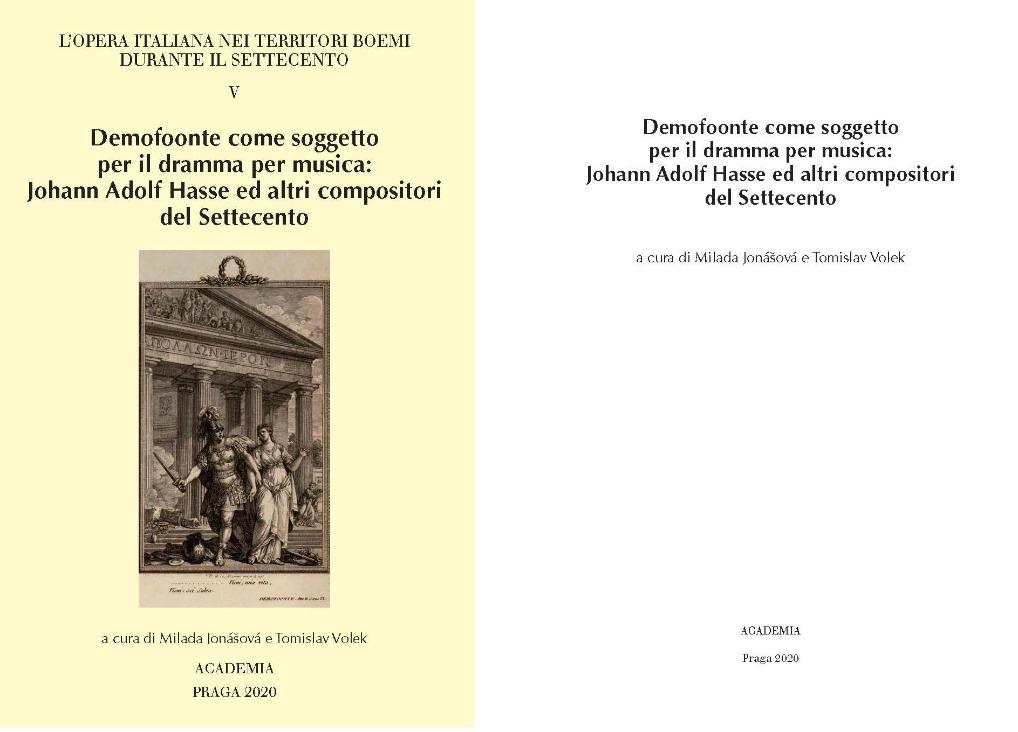
Demofoonte come soggetto per il dramma per musica:
Johann Adolf Hasse ed altri compositori del Settecento,
a cura di Milada Jonášová e Tomislav Volek, Praga: Academia – Artefactum, 2020
(= L’opera italiana nei territori boemi durante il Settecento 5), 344p.
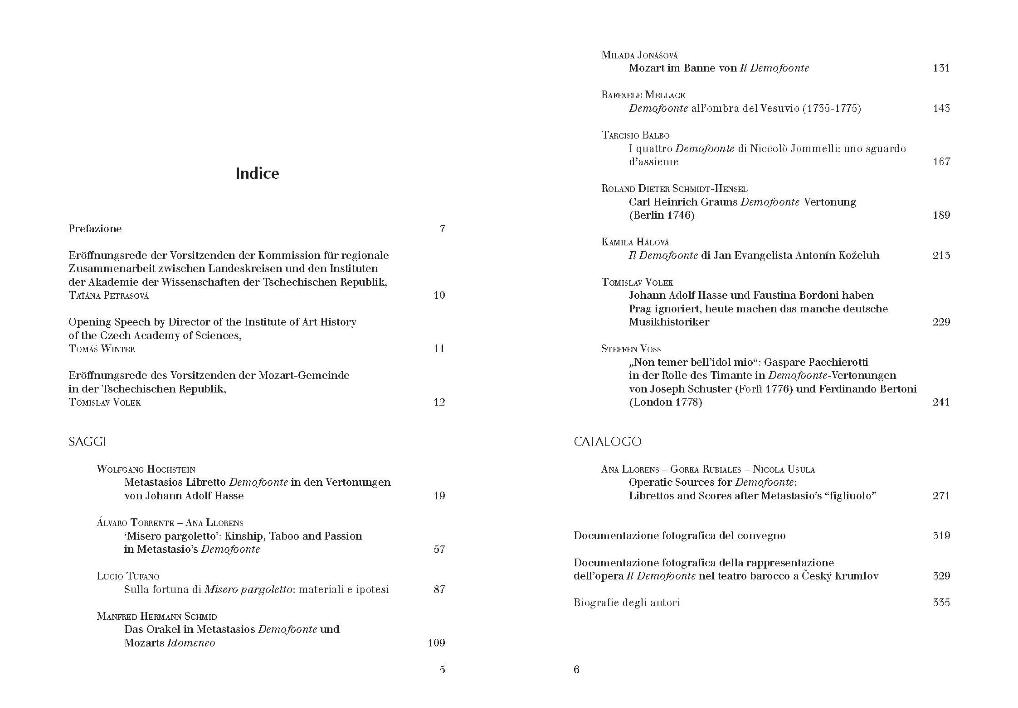
Sborník obsahuje referáty, které byly předneseny v průběhu 5. konference o italských operách v Čechách v 18. století. Uspořádaly ji v roce 2019 pod názvem Il Demofoonte jako námět dramatu per musica: Johann Adolf Hasse a další skladatelé 18. století a pod záštitou Italského kulturního institutu v Praze Ústav dějin umění AV ČR spolu s Centrem barokní kultury v Českém Krumlově a s Mozartovou obcí v ČR. Paralelně s konferencí se uskutečnila v českokrumlovském barokním zámeckém divadle novodobá premiéra Hasseho opery Il Demofoonte v provedení souboru Hof-Musici za řízení Ondřeje Macka. Obsáhlá vstupní studie Wolfganga Hochsteina pojednává Hasseho zhudebnění Metastasiova libreta Il Demofoonte na základě jejího provedení v dvorním divadle v Drážďanech (1748). Řada dalších skladatelů, ale i teoretiků, estetiků a spisovatelů byla Metastasiovým libretem inspirována, mnohé zaujal zvláště text árie domnělého syna krále Demofóna Timanta "Misero pargoletto". Zhudebněními uvedené árie nebo celého libreta různými skladateli se obírají Lucio Tufano, Álvaro Torrente, Raffaele Mellace, Stefen Voss a Roland Schmidt-Hensel. Manfred Hermann Schmid volil širší problematiku: způsoby zhudebnění božských sudeb (tzv. "orákula") od Demofoonta po Mozartova Idomenea. Sedm Mozartových árií na Metastasiova libreto pojednala Milada Jonášová. Unikátní skladatelský přístup Niccola Jommelliho, který zhudebnil Metastasiovo libreto Demofoonte dokonce ve čtyřech různých verzích, popsal Tarcisio Balbo. Také vyspělá pražská operní společnost přinesla v roce 1771 v divadle v Kotcích vlastního Demofoonta, a to ve zhudebnění Jana Evangelisty Koželuha, což pojednala Kamila Hálová. Tomislav Volek hledal příčiny neobvyklé historické skutečnosti, že pro pražskou italskou operní společnost Hasse žádnou operu nezkomponoval, a přesto se v českých archivech dochovalo množství jeho árií. Významným obohacením svazku je zařazení rozsáhlého katalogu libret a hudebních pramenů ke všem dosud známým operním zhudebněním Demofoonta v 18. století.
The volume contains papers presented at the Fifth Conference on Italian Opera in Bohemia in the Eighteenth Century, held in 2019 under the title Il Demofoonte as a Subject of Drama per musica: Johann Adolf Hasse and Other Eighteenth-Century Composers. The conference was organized under the auspices of the Italian Cultural Institute in Prague by the Institute of Art History of the Czech Academy of Sciences, in cooperation with the Centre for Baroque Culture in Český Krumlov and the Mozart Society in the Czech Republic. Parallel to the conference, a modern premiere of Johann Adolf Hasse’s opera Il Demofoonte took place in the Baroque Castle Theatre in Český Krumlov, performed by the ensemble Hof-Musici under the direction of Ondřej Macek. An extensive introductory study by Wolfgang Hochstein examines Hasse’s setting of Metastasio’s libretto Il Demofoonte on the basis of its performance at the court theatre in Dresden (1748). Metastasio’s libretto inspired numerous other composers as well as theorists, aestheticians, and writers; particular attention was drawn to the text of the aria of Demophon’s supposed son Timanthes, “Misero pargoletto.” Musical settings of this aria or of the entire libretto by various composers are discussed by Lucio Tufano, Álvaro Torrente, Raffaele Mellace, Steffen Voss, and Roland Schmidt-Hensel. Manfred Hermann Schmid addresses the topic from a broader perspective, focusing on musical treatments of divine destiny (so-called “oracles”) from Demofoonte to Mozart’s Idomeneo. Milada Jonášová examines seven Mozart arias based on Metastasio’s texts. Tarcisio Balbo describes the distinctive compositional approach of Niccolò Jommelli, who set Metastasio’s Demofoonte in no fewer than four different versions. The highly developed Prague opera company likewise produced its own Demofoonte in 1771 at the Theatre in the Kotce, set to music by Jan Evangelista Koželuh, a subject addressed by Kamila Hálová. Tomislav Volek investigates the reasons behind the unusual historical fact that Hasse never composed an opera for the Prague Italian opera company, despite the survival of numerous Hasse arias in Bohemian archives. A significant enrichment of the volume is the inclusion of an extensive catalogue of librettos and musical sources relating to all operatic settings of Demofoonte known to date from the eighteenth century.